


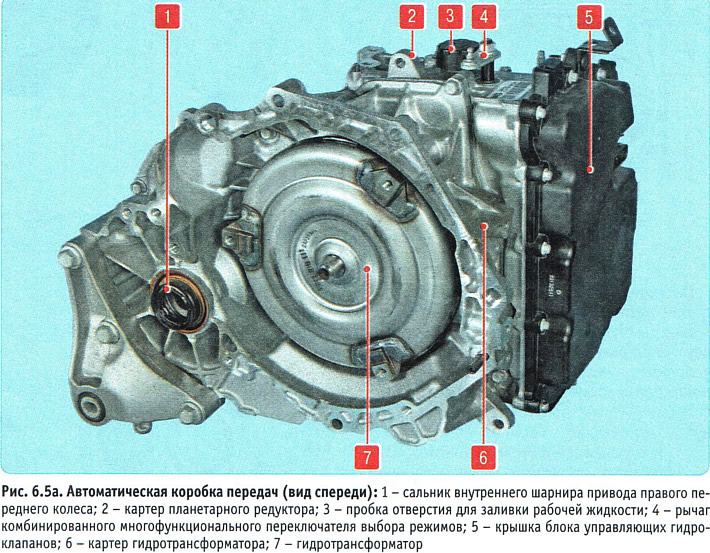
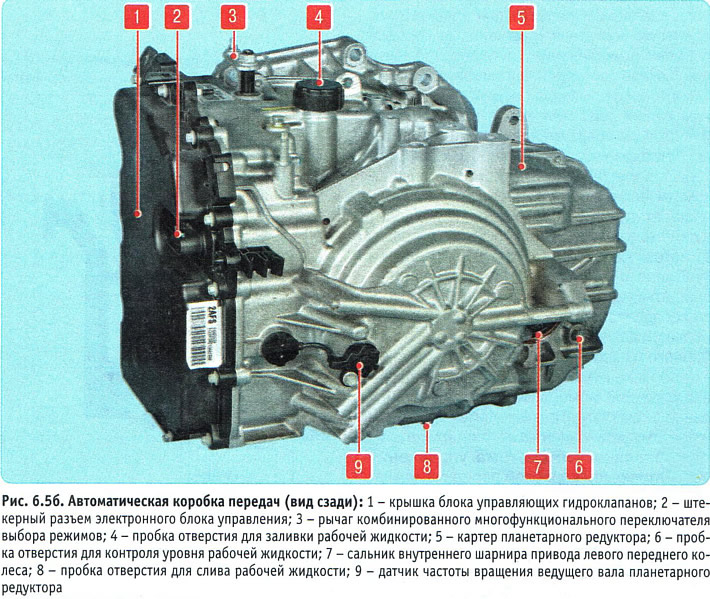
The automatic transmission is designed according to a traditional planetary scheme with friction braking and is connected to the engine crankshaft via a torque converter 7 (see figure 6.5 a). The torque converter uses a locking mechanism that reduces mechanical losses from slip between the pump and turbine wheels at medium and high driving speeds.
Gears in an automatic transmission are shifted using an electronic control unit that receives information about the engine condition, driving conditions and selects the moment of gear shifting according to road conditions and driving style. As a result, fuel efficiency is increased and the transmission performance is improved. In addition, the electronic transmission control system has a function for diagnosing faults and switching to emergency mode when they occur.
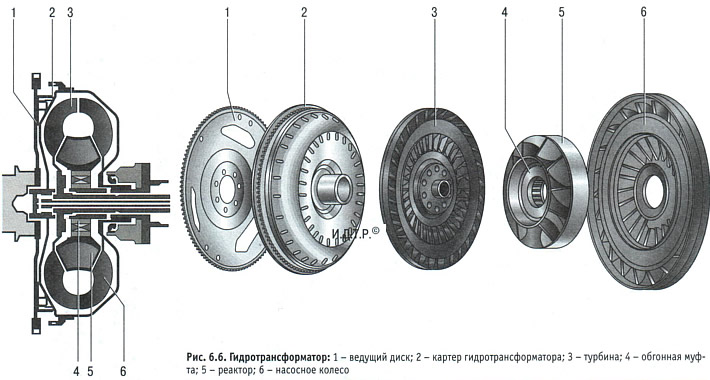
Torque converter (figure 6.6) plays the role of a clutch and serves to smoothly connect the engine and gearbox mechanism and increase torque when the car starts moving. The torque converter housing is connected to the engine crankshaft via a drive disk and constantly rotates when the engine is running. The internal cavity of the torque converter is filled with working fluid for automatic transmissions. The engine rotates the torque converter and drives the pump wheel, which creates flows of working fluid in the direction of the turbine wheel. The latter begins to rotate due to the flows of working fluid created by the pump wheel. With a large difference in the speeds of rotation of the turbine and pump wheels, the reactor changes the direction of the fluid flow, increasing the torque. As the speed difference decreases, it becomes unnecessary and is therefore installed on the overrunning clutch.
Hydraulic control system automatic transmission includes a pump, a pressure regulator, a spool valve for selecting the automatic transmission range, auxiliary valves (solenoids), hydraulic accumulators, clutches and brakes. The pressure in the hydraulic system is created by a pump installed in the front part of the gearbox housing. The pump ensures the operation of the torque converter, locking clutches, brakes and lubrication of the gearbox parts. The pressure created by the pump is regulated depending on the speed of the car and the load on the engine.
Planetary rows correspond to the gear block in a manual transmission and are used to change the gear ratio in an automatic transmission when shifting gears.
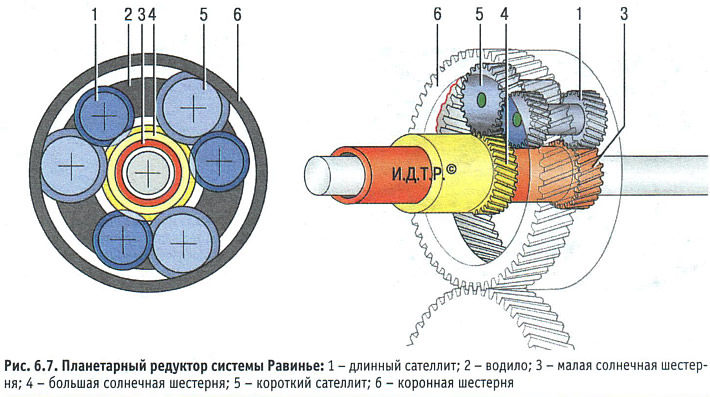
Planetary gearbox ravigne systems (figure 6.7) is a gear transmission with external and internal gear engagements, which provides various ways of connecting its elements to obtain different gear ratios.
Operating principle multi-plate clutches (figure 6.8) and disc brakes (figure 6.9) are very similar, the difference is that the multi-plate clutch connects the gearbox links to each other, and the disc brake connects to the gearbox housing. The working fluid supplied to the clutch activates the piston, and the friction disks are compressed. The links locked by the clutch begin to rotate as a single unit.
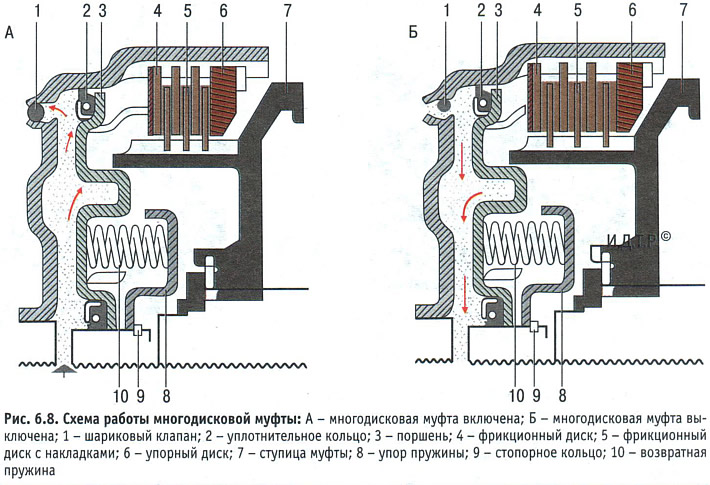
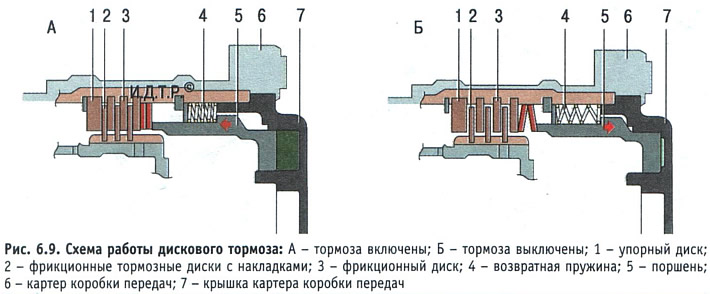
When the disc brakes are disengaged, the working fluid stops being supplied to the clutch and the piston, under the action of the return spring, returns to its original position.
The design feature of the multi-plate clutch is that it is in constant rotation and under the action of centrifugal force acting on the working fluid, pressure is created that does not allow the clutch to unlock. Additionally, a ball valve is installed in the clutch. It is located as close as possible to the edge of the center of the clutch. When the pressure of the working fluid in the chamber of the multi-plate clutch increases, the ball valve closes the drain hole, and when the pressure in the chamber decreases, the ball valve opens the drain hole under the action of centrifugal force and the clutch is unlocked.
The automatic transmission selector is mounted in the same location on the floor tunnel as the manual transmission control lever and is connected to the combined multi-function mode selector lever mounted in the transmission by a control cable.
A special feature of the automatic transmissions of the 2011 Chevrolet Aveo is the ability to switch from fully automatic control mode to manual mode (the so-called sequential gearbox), in which the driver independently selects the moment of switching to an upshift during acceleration of the car. This allows, if desired, to achieve more intense acceleration compared to the automatic mode, artificially delaying the switching to an upshift, and to bring the engine crankshaft speed to the maximum torque range. At the same time, the electronic control system constantly monitors the car speed and engine load, eliminates driver errors, not allowing him to engage a higher gear at low speed to avoid engine overload, or a downshift at too high a speed, which eliminates the possibility of exceeding the maximum permissible engine crankshaft speed. When the car speed decreases, the gears are automatically switched to lower ones without driver intervention. When the car comes to a complete stop, 1st gear is automatically engaged. The features of automatic transmission control are described in "The structure of the car" (cm. "Gearbox control").
The differential of an automatic transmission is similar in design to the differential of a manual transmission.
Repairing an automatic transmission requires a large set of special tools and appropriate training of the performer, so this section only covers removing and installing the transmission, replacing its seals, and repairing the drive. If necessary, repair the transmission at a specialized service center.
(The original material is located on the website ChevyMan.ru)