


2. Remove the caliper, move it aside and secure it. Check the condition of the disc on both sides. If traces of deep wear are found, (depth more than 0.38 mm) remove the disk and polish it at a car service (see photo).
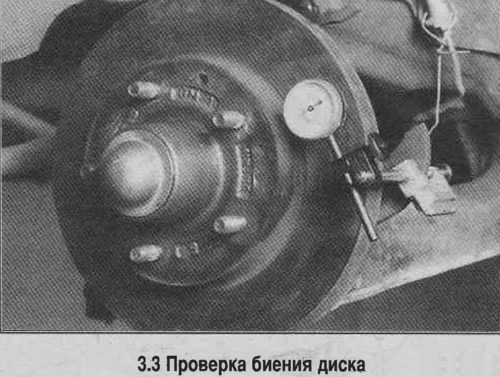
3. Check the disc runout along its edge using a dial indicator (see photo). If the runout on the indicator exceeds the norm, remove the disk and grind it. On all-wheel drive models, tighten the 2 wheel nuts in place to secure the disk relative to the hub. The flat surfaces of the nuts should face the disk. If the runout on the indicator exceeds the norm (0.15 mm), remove the disk and grind it.
Attention! It is generally recommended to periodically remove and polish the disk regardless of the indicator readings. At least, this can be done by hand with fine sandpaper (see photo), to reduce roughness.
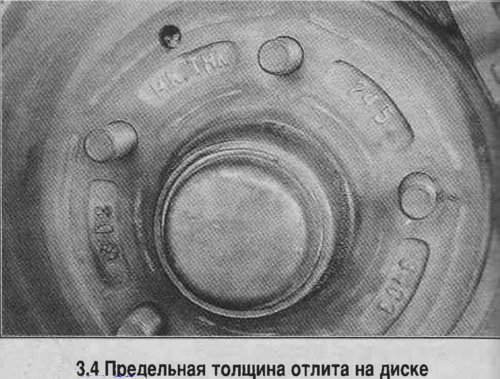
4. After grinding, the thickness of the disk should not be less than the maximum permissible thickness, which is cast on the disk (see photo).
5. On rear-wheel drive models (4x2), the brake disc is made integral with the front wheel hub. Removal and installation of the hub are discussed in the wheel bearing maintenance procedure (see Chapter 1). On all four-wheel drive models (4x4) (except the one-ton (K-30) model), the disk can be removed from the hub after removing the wheel and brake caliper. On the One-Tone K-30 and all-wheel drive (4x4) models, the disk is pressed onto the hub and is removed complete with the hub and bearing (see Chapter 10). If a disc replacement is necessary, take the hub unit to a car service center to have the old disc removed and a new one pressed on.